UV Protection
Can Sunglasses Be 100% UV Protection?
The short answer is yes. The longer answer explains why most sunglasses do not, what the 100% claim actually means, and what you need to look for to verify it.
🕑 5 min read☀️ UV protection🇨🇳 India
In this article
- What 100% UV protection means
- UV400 — the standard that delivers it
- The dark lens myth
- Why most sunglasses fall short
- How to verify UV protection before buying
What 100% UV protection means

When a sunglass brand says 100% UV protection, it should mean the lenses block all UVA and UVB rays — the two types of ultraviolet radiation that reach the Earth’s surface and accumulate as damage in your eyes over time. 100% protection means zero UV radiation passes through the lens.
The qualification: not all sunglasses that claim UV protection actually deliver this. The 100% figure needs to come with a specific standard behind it.
UV400 — the standard that delivers it

UV400 is the scientific standard for 100% UV protection. It means the lens blocks all electromagnetic radiation with wavelengths up to 400 nanometres. This covers:
UVA blocked
315–400nm. The more prevalent type. Penetrates cloud cover and glass. Linked to cataracts and lens clouding over time.
UVB blocked
280–315nm. Less prevalent but more acute. Causes photokeratitis (corneal sunburn). Linked to certain cataract types.
UV400 = 100% UVA + 100% UVB. These two terms, when verified, mean the same thing.
The dark lens myth

Important
A dark tinted lens without UV400 certification is more dangerous than no sunglasses at all. Here is why: the dark tint causes your pupil to dilate because the brain perceives lower light levels. But without a UV filter, full UV radiation enters the eye through that wider pupil. The UV damage is invisible in the moment and cumulative over years.
UV protection is a chemical property of the lens material — not the tint. A completely clear lens with UV400 coating blocks exactly the same UV as a very dark lens with the same coating. The tint only affects visible light transmission. UV filtering is an entirely separate feature.
Why most sunglasses fall short

Several reasons sunglasses fail to deliver on UV claims:
Unverified
“UV resistant” or “UV protection” with no percentage or standard. These phrases have no regulatory definition in India and may mean anything or nothing.
Degraded
Surface-applied UV coatings on cheap sunglasses wear off within months of normal use. UV400 coating built into the lens material does not degrade with use.
Tint only
Many unbranded sunglasses are sold with dark tints and no UV coating at all. These are the most dangerous type — they create the impression of protection with none of its reality.
Partial
Some UV specifications only cover UVB (the more commonly measured type) and leave UVA exposure unaddressed. UV400 is the only label that guarantees both.
How to verify UV protection before buying

What to look for
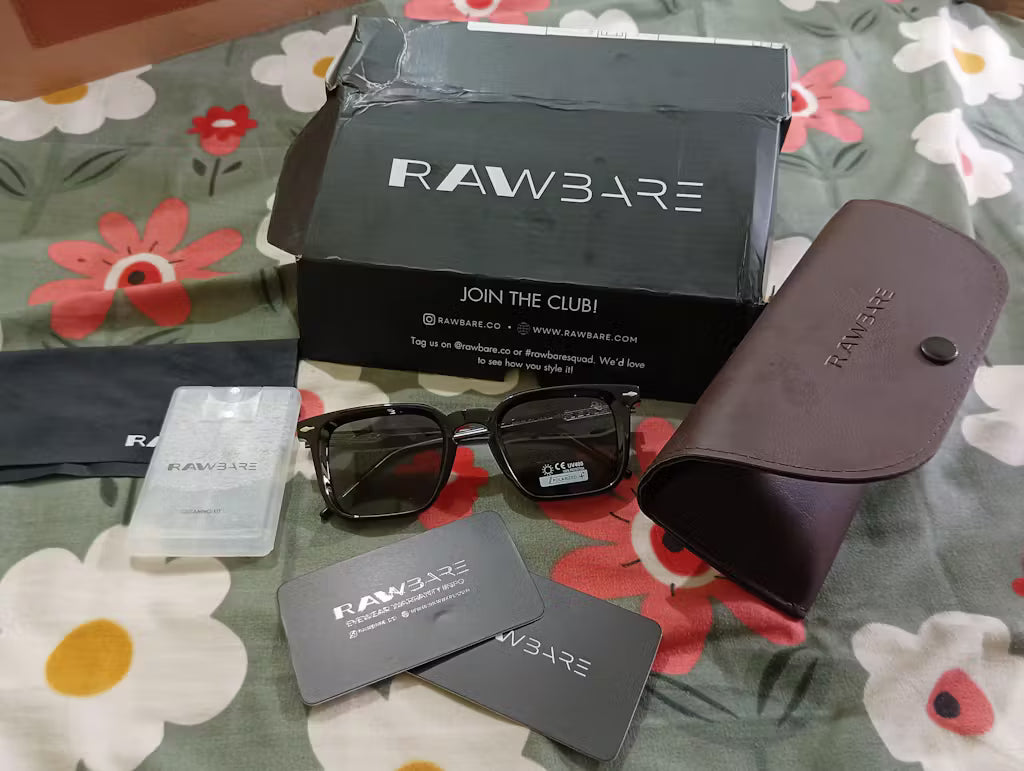
The product tag, packaging, or product page should explicitly state UV400 or 100% UV protection. If the claim is only “UV resistant”, “anti-UV”, or has no number attached, do not assume coverage. Every Rawbare frame ships with UV400 built into the lens material as a standard feature across the full range.
Browse Rawbare UV400 polarized sunglasses
Key takeaways
✓ 100% UV protection = UV400 = blocks all UVA and UVB rays
✓ Dark tints without UV400 are more dangerous than no sunglasses
✓ UV coating is a lens property — not related to tint colour or darkness
✓ Surface UV coatings degrade; UV400 built into the lens material does not
✓ “UV resistant” with no percentage is not a meaningful protection claim
Q1 Can sunglasses really provide 100% UV protection?
Yes — sunglasses labeled UV400 block 99 to 100 percent of both UVA and UVB rays. Protection depends entirely on the lens coating, not the tint or price of the frame.
Q2 Does a darker lens mean better UV protection?
No. Lens darkness has no bearing on UV protection. The coating does the work, not the tint. A dark lens without UV400 certification is actually more dangerous than no sunglasses at all.
Q3 What is the difference between UV400 and UV protection?
UV400 is a specific standard that blocks all UV light up to 400 nanometres. Generic ‘UV protection’ claims may only partially block UV. UV400 is the only label that guarantees complete coverage.
Q4 Do wraparound frames offer more UV protection?
Yes. Wraparound and oversized frames block UV that enters from the sides and above, which standard flat frames leave exposed. Up to 50% of ocular UV exposure can enter from the sides.
Q5 Are all Rawbare sunglasses UV400?
Yes — every Rawbare frame carries UV400 protection as a standard feature across the entire range. It is not an upgrade or premium option — every pair ships with it.