UV & Eye Health · Trust
How to Spot Real UV Protection vs Fake Sunglasses
A dark lens with no UV filter is not just useless — it is worse than wearing nothing at all. Here is how to tell genuine UV protection from a fake, and the simple checks anyone can do.
🕑 7 min read🛡 UV protection✅ Trust
In this article
- Why a fake dark lens is more dangerous than no sunglasses
- The myth: dark equals protected
- How to check UV protection before you buy
- How to check a pair you already own
- Red flags of fake UV sunglasses
- Why buying from a real brand removes the guesswork
- Rawbare frames with verified UV400
- Frequently asked questions
In one sentence
The darkness of a lens tells you nothing about its UV protection — only a verified UV400 rating does — and a dark lens without that rating actively increases the UV reaching your eyes.
Why a fake dark lens is more dangerous than no sunglasses
This is the single most important thing to understand about UV protection, and it is counter-intuitive. When your eyes are in bright light, your pupils contract to limit how much light, and how much UV, gets in. When you put on a dark lens, your eyes read the scene as dimmer and your pupils open wider to let more light in.
If that dark lens has genuine UV400 protection, this is fine — the UV is filtered out before it reaches your wide-open pupils. But if the lens is just a dark tint with no UV filter, you have created the worst possible situation: wide pupils letting in more light than usual, with the full dose of UV passing straight through. A fake dark lens therefore delivers more UV to the eye than wearing no sunglasses at all.
The real risk
Cheap, unbranded street-market sunglasses are the most common source of this problem. They look protective, they feel protective, and they can be doing active harm. This is why verifying UV protection matters more than any style decision.
The myth: dark equals protected

Lens darkness and UV protection are two completely independent properties. Darkness is about visible light. UV protection is about invisible ultraviolet radiation. A pale, barely-tinted lens can block 100% of UV, and a near-black lens can block none. One has nothing to do with the other.
UV protection comes from the lens material and its treatment, not its colour. The only thing that tells you a lens is protective is a stated, verifiable UV400 or 100% UV rating. We break the standard down fully in what UV400 actually means, and this is one of several common sunglasses myths worth unlearning.
How to check UV protection before you buy

1
Genuine protective sunglasses state UV400 or 100% UV protection explicitly, on the product page, the tag, or the lens sticker. Vague phrases like "UV protected" without a number are a warning sign.
2
A real brand ties its name and warranty to the UV400 rating. An anonymous street stall or marketplace listing with no brand has nothing at stake if the claim is false.
3
If a pair imitates an expensive brand at a fraction of the price with no UV specification of its own, the lens quality and UV protection are unverified. The look is copied; the protection often is not.
How to check a pair you already own

If you already have a pair and are unsure, you have a few options:
| Method |
What it tells you |
| Optician UV meter |
The most reliable check. Many opticians will test a lens on a photometer in seconds, often for free, and tell you the exact UV blocking. |
| Check the original label |
If the pair came with a UV400 or 100% UV sticker or tag from a named brand, that is a reliable indicator. No label and no brand means no assurance. |
| Brand verification |
Look up the exact model on the brand's official site. A genuine brand lists the UV rating for each frame. |
A note on home tests
No reliable at-home test exists to measure UV blocking with the naked eye, because UV is invisible. Tricks involving phone screens or torches test for polarization or tint, not UV. When in doubt, an optician's UV meter is the only definitive answer.
Red flags of fake UV sunglasses
✕
No number, no UV400, no 100% UV — just a vague claim or nothing at all.
✕
Nobody is accountable for the claim, and there is no recourse if it is false.
✕
The styling is copied but no genuine lens specification is provided.
✕
Wavy distortion when you move the lens, uneven tint, or visible flaws suggest low-grade manufacturing where UV treatment is unlikely to be reliable.
Why buying from a real brand removes the guesswork

The simplest way to never worry about fake UV protection is to buy from a brand that builds UV400 into every frame as standard and stakes its name on it. When the rating is consistent across the entire range and backed by a warranty, there is no individual pair to second-guess.
Rawbare guarantee
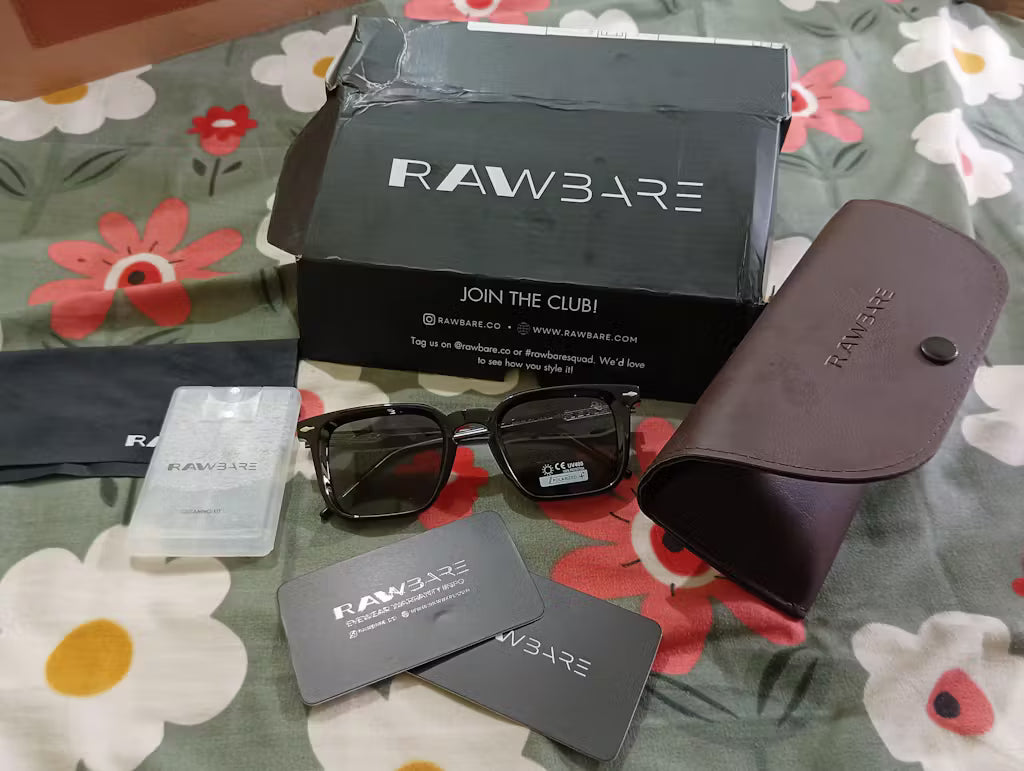
Every Rawbare frame carries 100% UV400 protection as standard, built into the lens — never an upgrade, never an add-on. Each pair is backed by a 6-month warranty, so the protection you are promised is the protection you get. Explore the full
collection.
Rawbare frames with verified UV400
A few in-stock everyday frames, each with genuine UV400 built in.

Metal Aviator — Silver Black
UV400 • Aviator
View Frame
Key takeaways
✓ A dark lens with no UV filter delivers more UV to the eye than wearing nothing
✓ Lens darkness and UV protection are completely unrelated properties
✓ Only a stated, verifiable UV400 or 100% UV rating confirms protection
✓ An optician's UV meter is the only definitive test for a pair you own
✓ No UV rating, no brand, and no warranty are the main red flags
✓ Buying from a brand with UV400 as standard removes the guesswork
Frequently asked questions
Q1 How do I know if my sunglasses really block UV?
The only definitive way is a UV rating you can verify: a stated UV400 or 100% UV label from a named brand, or a test on an optician's UV meter, which many opticians do quickly and often for free. Lens darkness, price, and appearance tell you nothing about actual UV protection.
Q2 Are dark sunglasses without UV protection dangerous?
Yes. A dark lens makes your pupils widen to let in more light. If the lens has no UV filter, those wider pupils allow more UV into the eye than if you wore no sunglasses at all. This makes fake dark sunglasses actively harmful, not just useless.
Q3 Can I test UV protection at home?
There is no reliable naked-eye home test, because UV is invisible. Tricks using phone screens or torches actually test for polarization or tint, not UV blocking. The dependable options are checking a genuine UV400 label from a named brand or using an optician's UV meter.
Q4 Do cheap sunglasses have UV protection?
Price alone does not determine UV protection. Some inexpensive sunglasses from reputable brands include genuine UV400, while some unbranded street-market pairs at any price do not. What matters is a verifiable UV400 rating backed by a brand, not the price tag.
Q5 Do Rawbare sunglasses have verified UV protection?
Yes. Every Rawbare frame includes 100% UV400 protection as standard, built into the lens rather than added as a coating, and each pair is backed by a 6-month warranty. The UV400 rating is consistent across the entire range.